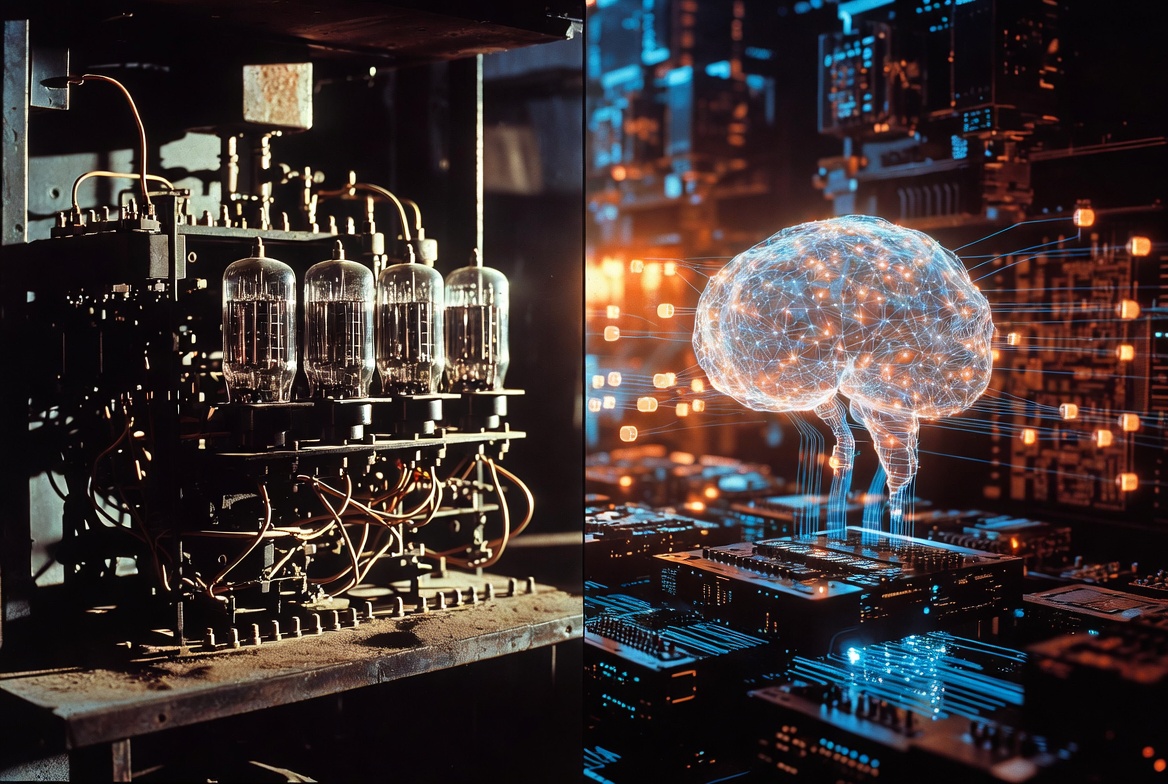
Frank Rosenblatt’s revolutionary 1958 creation.
The first artificial neural network.
The spark that ignited modern AI.
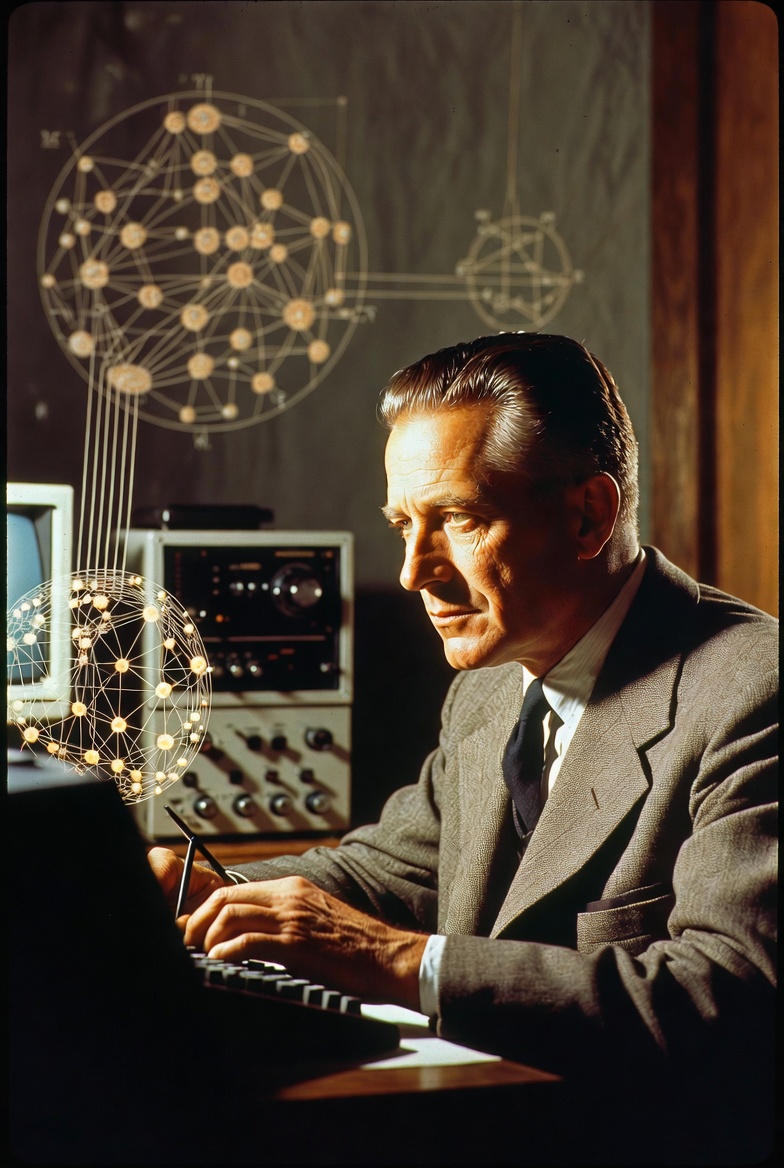
In 1957, at the Cornell Aeronautical Laboratory in Buffalo, New York, psychologist Frank Rosenblatt (1928–1971) built something extraordinary: a machine that could learn from experience.
Drawing inspiration from biological neurons and the work of Warren McCulloch and Walter Pitts, Rosenblatt created the Perceptron — the world’s first artificial neural network capable of supervised learning. It wasn’t just programmed; it adapted.
Rosenblatt was optimistic, even poetic. He described it as “the first machine which is capable of having an original idea.” In an era of room-sized computers and punch cards, this was radical thinking.
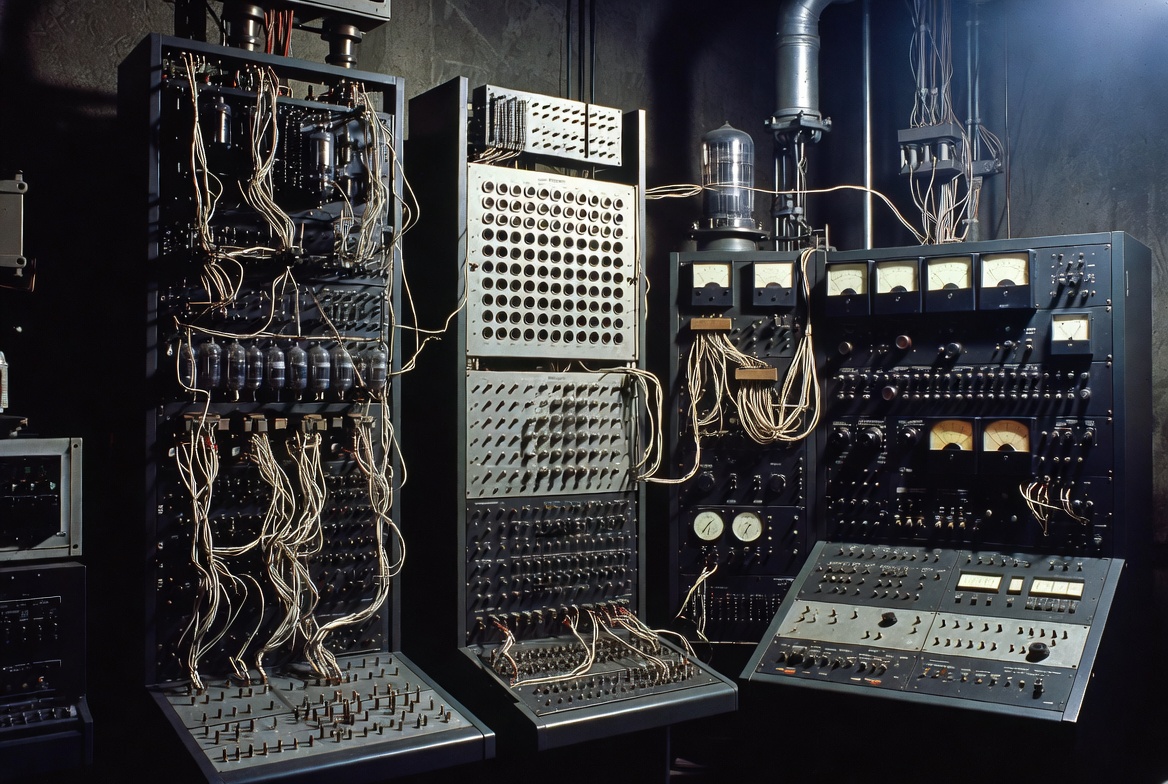
A room-sized electronic brain with a 20×20 photocell “retina” that could classify visual patterns through learning.
The Perceptron computed a weighted sum of its inputs and fired (output 1) if the sum exceeded a threshold (bias). Otherwise, it stayed off (output 0).
During training, if it made a mistake, the weights were adjusted proportionally to the error — the famous perceptron learning rule.
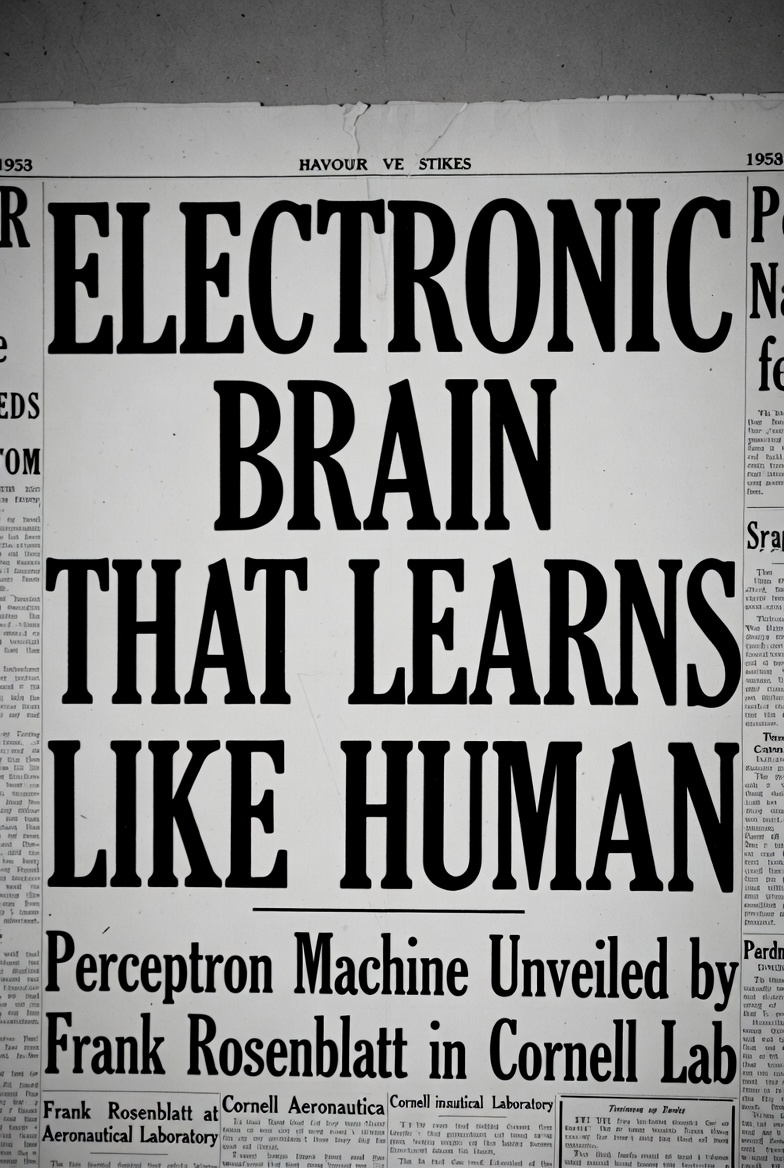
Public demonstrations and press coverage were sensational. Headlines proclaimed machines that could “see,” “learn,” and even “think.”
Rosenblatt’s work captured the imagination of scientists, military funders (ONR support), and the public. It felt like science fiction becoming reality.
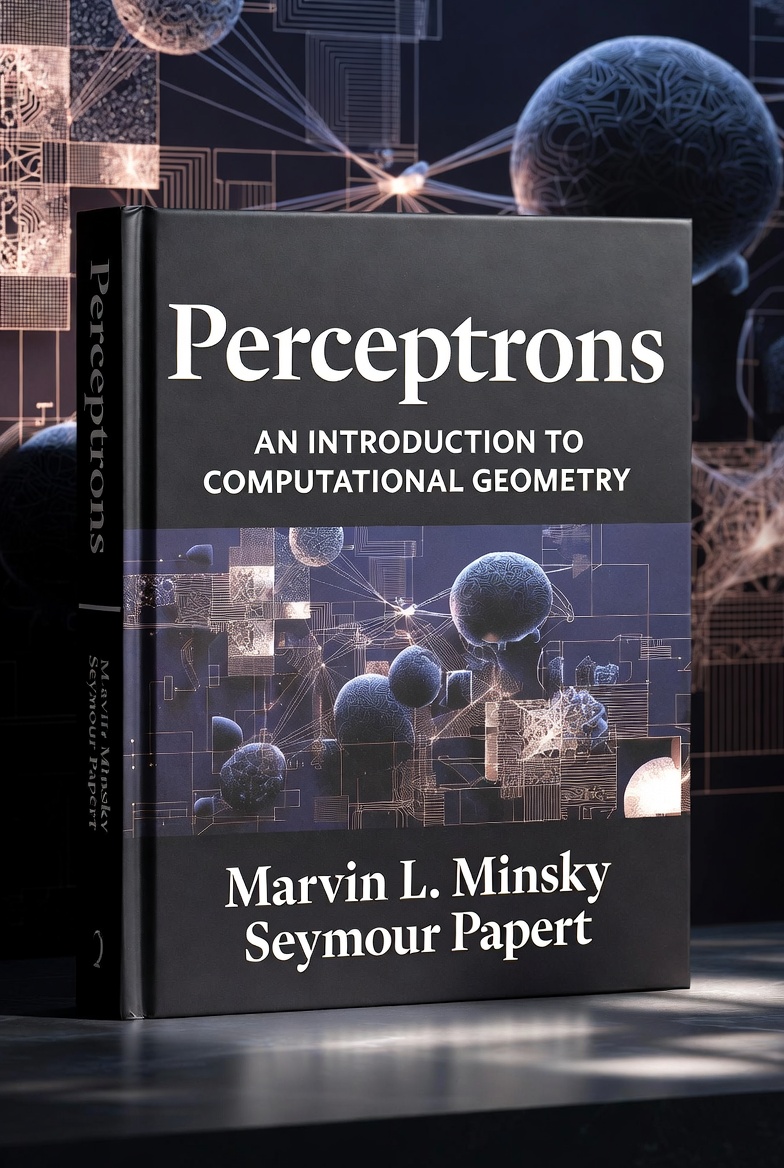
Marvin Minsky and Seymour Papert published a rigorous mathematical analysis showing the severe limitations of single-layer perceptrons, particularly their inability to solve non-linearly separable problems like the XOR function.
While the book focused on single-layer models and Rosenblatt had explored multi-layer ideas, it was widely interpreted as a death knell for neural network research.
The limitations were real for single-layer models, but the core idea — networks of simple units that learn by adjusting connections — was profoundly correct.
In the 1980s, the backpropagation algorithm (popularized by Rumelhart, Hinton, and Williams) enabled training of multi-layer networks. Suddenly, non-linear problems like XOR became solvable. Neural networks roared back.
Today’s deep learning — the technology behind ChatGPT, image generators, autonomous driving, and more — is the direct descendant of Rosenblatt’s Perceptron. Modern networks are vastly deeper, use different activation functions, and train on massive data with GPUs, but the foundational principle of learned representations through weighted connections remains the same.
Experiment with a simple digital Perceptron. See why single-layer models struggle with certain patterns.
This site is a complete conceptual foundation — ready for expansion into a full documentary series, interactive museum experience, or educational platform.